
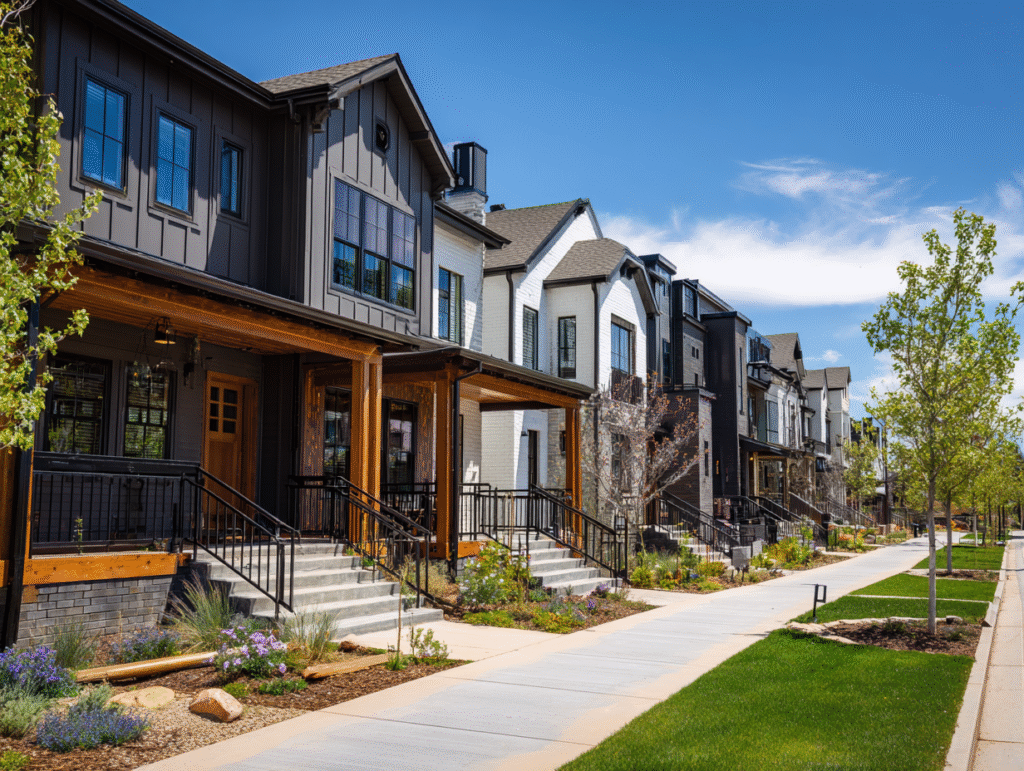
As investors and developers look for the next opportunity in residential real estate, the build-to-rent (BTR) model is gaining serious traction. But how does BTR stack up against more traditional multifamily (MF) assets? We dug into the latest data to see where the opportunities and risks lie, especially in high-growth markets like Colorado.
What is BTR?
Build-to-rent (BTR) refers to purpose-built rental communities of single-family homes, townhomes or duplexes (often professionally managed and owned by a single entity) rather than scattered individual rental SFRs or multi-unit apartment buildings. CBRE
They offer a unique combination: the space, yards, and neighborhood feel of single-family homes, with the convenience and scale of institutional rental operations.
Supply & Scale
In the 12 months to June 2025, starts of BTR/horizontal SFR rental communities were estimated at ~71,000 units, representing about ~7.2% of single-family housing starts. Nationwide, BTR continues to scale rapidly. For example:
- A recent white-paper noted 27% year-over-year growth in the BTR sector in 2024, with $14.8 billion in institutional capital deployed. Cavan Companies
- According to the CBRE 2024 BTR overview, average BTR rent growth decelerated to ~1.5% YoY in Q2 2024, compared with ~0.3% for traditional multifamily (on a national average basis). CBRE
- Meanwhile, traditional multifamily is facing a supply headwind: for example, starts of 5+ unit multifamily dropped to an annualised rate of roughly 316,000 units in May 2025. NAA HQ+1
Positioning: BTR vs. MF
Household preferences & space:
- BTR appeals to households seeking more space, yards, and less dense living—often families, remote workers, or downsizing occupants.
- Traditional MF remains strong for renters prioritizing proximity to urban employment, transit, and amenity-rich living, but may have less yard/private-outdoor space, and more unit sharing of walls.
Operating focus & structure:
- BTR communities typically operate more like horizontal SFR rental estates: lower parking ratios (in some markets), unit maintenance geared to single-family lifecycle, and property management optimized for yards, site amenities, and tenant retention in family-oriented communities.
- MF tends to operate in vertical buildings with shared common elements, higher density, and different cap-ex/turnover dynamics.
- From a developer/investor perspective, BTR can offer differentiated product and a growing niche, while MF remains a staple but increasingly commoditised and competitive asset class.
Why It Matters In Colorado (and Similar Growth Submarkets)
- Markets like Colorado’s growth corridors are seeing elevated household formation, increasing demand for rental housing that can accommodate families and longer-term occupancy.
- BTR aligns well in these submarkets: single-family–style rentals in growth areas where supply of for-sale homes is constrained and rental alternatives are limited.
- Hence, the strategic appeal: allocating capital to BTR in these growth corridors can capture both residential demand trends and real estate scarcity.
Performance Snapshot & Takeaways
- While BTR’s national rent growth has decelerated (~1.5% YoY in Q2 2024) it still out-paced traditional MF in that period. CBRE+1
- Vacancy in many BTR markets remains relatively low (below ~5 %) giving pricing power. Multi-Housing News
- For MF, forecasts suggest rent growth of ~2.2% for 2025 and vacancy rising to ~6.2 % in some markets. Freddie Mac Multifamily
- The takeaway: BTR is not a slam dunk—it comes with its own supply-cycle risks (just like MF). But the structural tailwinds (household formation, preference shifts, single-family rental supply shortage) make it a compelling alternative.
Conclusion
For investors and developers operating in Colorado or similar growth markets, the shift toward BTR deserves serious consideration. While traditional MF remains relevant, BTR presents a differentiated product with appealing demand characteristics and operating dynamics. The data shows that BTR is no longer niche—it’s increasingly institutional. That said, as always, local market fundamentals (land cost, zoning, construction cost, submarket growth) matter just as much as national trends.