

Over the past decade, Colorado’s Front Range has continued to evolve, shifting its center of gravity from core metro hubs toward the expanding belt north of Denver. Among the communities gaining momentum as part of this next wave is Firestone, Colorado. With access to both Denver and Boulder, growing infrastructure, and strong demographic fundamentals, Firestone represents a powerful convergence of lifestyle appeal and investment opportunity.
Where Location Meets Opportunity
Located roughly 30–40 minutes from both Denver and Boulder, Firestone offers a rare combination of proximity to major metros and a more open-space, suburban feel. According to the Town’s official profile, the population is estimated at 19,200 within an area of about 14.2 square miles (firestoneco.gov).
Between 2020 and 2024, the town grew from approximately 16,372 to 19,396 residents, marking a growth rate of nearly 18.5% in just four years (census.gov). Historical data shows that from 2000 to 2023 the population increased more than 600%, an average annual growth rate of about 26.7% (neilsberg.com).
In a climate where housing and land near Denver and Boulder have become increasingly constrained, this corridor is offering both space and access, making communities like Firestone appealing for relocation, second-home buyers, and investors alike.
Demographics & Socio-Economics
Firestone’s profile is solid across several key metrics:
- Median household income: ~$114,591 (2023) for approximately 5,877 households.
- Average household income: ~$129,768 in 2023, up 4.6% year over year.
- Per capita income: ~$63,964 (2025 projection) with a very low poverty rate of 3.85%
- Median age: ~35.6 years, signaling an affluent, younger working demographic.
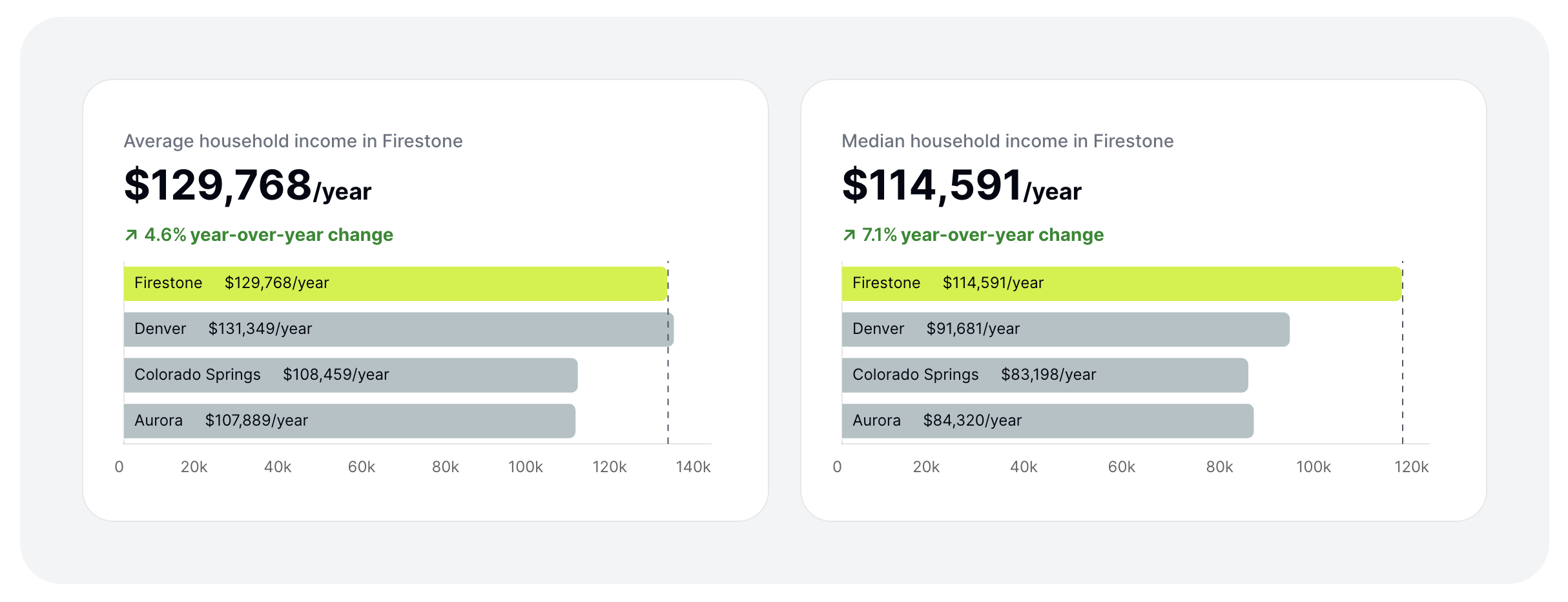
Source: (point2homes)
These numbers tell a story. Firestone is not just growing; it’s attracting higher-income working professionals and families. That profile supports both demand for housing and long-term appreciation potential.
Housing & Real Estate Metrics
In terms of housing, the market shows characteristics of both maturity and room for growth:
- Median home value: ~$468,783, according to Livability (livability.com).
- Zillow’s Home Value Index lists the average home value at ~$572,194, reflecting a modest 2% decline over the past year (zillow.com).
- Average rent: ~$3,079 (September 2025), well above the U.S. average of ~$1,979 (zillow.com).
Together, these data points indicate that Firestone is no longer a “hidden” affordable fringe. It sits at a price point that reflects its desirability yet remains accessible compared to Boulder or Denver’s most competitive markets.
Infrastructure and Growth Drivers
Firestone’s growth is strategic, not accidental. Its location along Interstate 25, combined with proximity to Boulder’s innovation economy and Denver’s employment hub, creates a strong foundation for sustainable expansion.

New retail, residential, and mixed-use developments are emerging to serve a population of families, remote professionals, and entrepreneurs who want balance between open space and connectivity. The Town’s demographic projection for 2030 estimates a population of roughly 22,219 (firestoneco.gov).
From an investor’s perspective, the continued influx of higher-income households and the expansion of local amenities suggest that land and housing values will continue to appreciate over time.
Why This Corridor Matters
The “north of Denver, close to Boulder” story resonates for several reasons:
- Affordability pressure elsewhere: As Boulder and nearby Denver suburbs become increasingly expensive, the northern belt offers better value without compromising on quality of life.
- Lifestyle alignment: For professionals who value outdoor recreation, open space, and family-friendly neighborhoods, Firestone and its neighboring towns are an ideal fit.
- Investment runway: Rapid population and income growth paired with relatively moderate pricing create significant upside potential.
- Commuter access and quality of life: Firestone offers easy access to major employment hubs while providing suburban tranquility and small-town charm.
Considerations and Realities
Every high-growth community faces challenges. While Firestone’s overall crime rate remains moderate, property crime sits slightly above the national average, with a roughly 1 in 86 chance of occurrence (neighborhoodscout.com). Rapid expansion can also strain infrastructure, increase traffic, and pressure school systems.
Even so, the town’s governance and planning appear focused on managing that growth sustainably. While home prices have risen substantially, they still represent a strategic entry point compared to the ultra-premium zones of Denver or Boulder.
The Next Decade Belongs Here
Whether you’re searching for a place to call home or scouting a region ripe for long-term investment, the stretch north of Denver—including Firestone—is where Colorado’s next chapter is unfolding.
Its fundamentals are clear: strong demographics, rising income levels, expanding infrastructure, and a balance of access and affordability. Firestone and its surrounding communities represent the next evolution of Colorado’s Front Range—where opportunity meets livability.
At Arete Real Estate, we focus on high-growth corridors like this one. To explore current investment opportunities or discuss our Colorado market insights, click here to book a call or email info@areterealestate.co